CERN consumes the most electricity when its most powerful accelerator, the Large Hadron Collider (LHC), is running, which consumes roughly half of CERN’s electricity. CERN has a typical yearly consumption of about 1.2 terawatt-hours (based on the consumption of the year 2012 when the LHC was running). This figure represents approximately a third of the consumption of the Canton of Geneva.
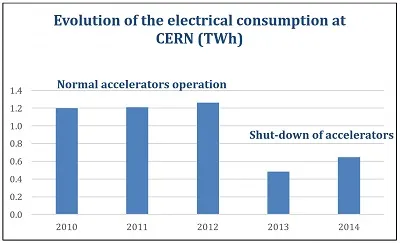
A large proportion of the LHC’s electrical consumption keeps the superconducting magnet system at its operating temperatures (-271°C for most of the magnets). This superconducting property means that the energy consumption of the LHC is similar to that of its predecessor, the Large Electron-Positon collider (LEP), which has operated since the 80s, despite the LHC being a much more powerful machine.
Roughly 135 tonnes of liquid helium are necessary to maintain the LHC at very low temperatures. The helium is stored in a closed circuit and when the machine is stopped, the gas is partially stored in special tanks and partially sent back to the supplying companies.
Related articles
No posts were found. Try to change the category or the date filters.