CERN adheres to an internationally recognised radiation protection system that continuously strives to minimize radiation exposure and, consequently, CERN’s emissions remain consistently well below regulatory limits.
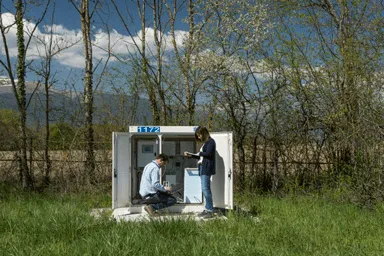
CERN’s radiation protection team surveys the ionising radiation produced inside the facilities and close to the facilities. Alarmed gate-monitors are installed and managed by CERN’s radiation protection team to prevent the uncontrolled export and import of radioactive materials. The CERN Safety & Environment teams take samples of ambient air, soil, river water, groundwater, rainwater, vegetation and agricultural products from the surrounding environment, and carry out thousands of analyses on these samples every year.
CERN imposes limits on the exposure of staff and visitors according to EU law. All of CERN’s personnel working in sensitive areas is monitored by the Dosimetry Service of CERN’s radiation protection group, which is accredited by Switzerland. The Service distributes dosimeters that measure the exposure of each worker to ionizing radiation. CERN is very committed to ALARA implying a state-of-the-art job and dose planning for works in CERN’s radiation areas aiming to minimise the dose to the workers.
Since the LHC experiments are underground, this provides a natural barrier to radiation. CERN’s radiation protection team generates computer simulations of the radiation fields of existing and planned facilities, such as the LHC, to anticipate any problems ahead of time. In this way, CERN predicts and minimizes its environmental impact before any facilities are constructed.
Related articles
No posts were found. Try to change the category or the date filters.