Tag: HL-LHC
-
What was the work schedule?
What was the work schedule? The HL-LHC civil engineering works began in May 2018 and lasted five years. All foreseen underground and surface works were successfully completed in September 2022 at Point 1 and in December 2022 at Point 5. Related articles
-
Who carried out the work?
Who carried out the work? The HL-LHC civil engineering project is based on four main contracts. Two consultancy service contracts are dedicated to the design and to the construction administration: SETEC–CSD–ROCKSOIL (ORIGIN) at Point 1 and LOMBARDI–ARTELIA–PINI (LAP) at Point 5. Two supply contracts are dedicated to the construction of both the underground and surface
-
What civil engineering work was required for the High-Luminosity LHC?
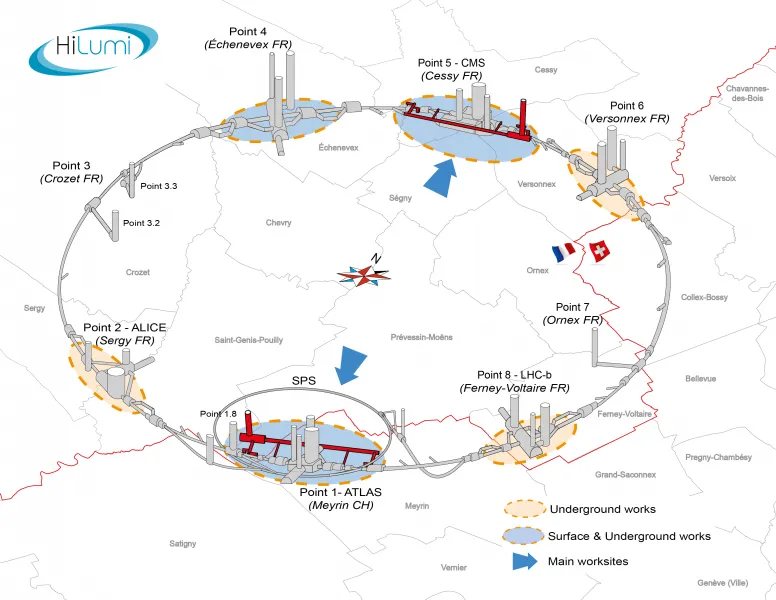
What civil engineering work was required for the High-Luminosity LHC? The new equipment for the High-Luminosity LHC requires new large civil engineering structures on the sites of the ATLAS experiment in Meyrin, Switzerland (LHC Point 1) and the CMS experiment in Cessy, France (LHC Point 5). On each site, the underground constructions consist of: –
-

Selection of public events to (re-)watch at home
Selection of public events to (re-)watch at home Everyone is encouraged to stay at home. Why not take this opportunity to watch the video recordings of the many events that took place at the Globe previously? Taking part in the global effort to limit the spread of COVID-19, CERN has cancelled its programme of free
-
The High-Luminosity LHC (HL-LHC)
The High-Luminosity LHC project will allow the LHC to be exploited to its full potential. CERN’s Large Hadron Collider (LHC) is the world’s largest and most powerful particle accelerator. It has been operating successfully since 2008. The data collected from the LHC allowed the ATLAS and CMS experiments to discover the Higgs boson after decades
-
Public presentations of the HL-LHC project
Public presentations of the HL-LHC project CERN scientists will meet their neighbours to present the HL-LHC project and answer questions The High-Luminosity Large Hadron Collider (HL-LHC): the future of the LHC CERN’s Large Hadron Collider (LHC) is the world’s largest and most powerful particle accelerator. It has operated successfully since 2008 and at very high
-
CERN prepares its long-term future
CERN prepares its long-term future The HL (High Luminosity) LHC is CERN’s number-one priority and will increase the number of collisions accumulated in the experiments by a factor of ten from 2024 onwards Geneva, 6 February 2014. Particle physics takes the long-term view. Originally conceived in the 1980s, the LHC took another 25 years to
