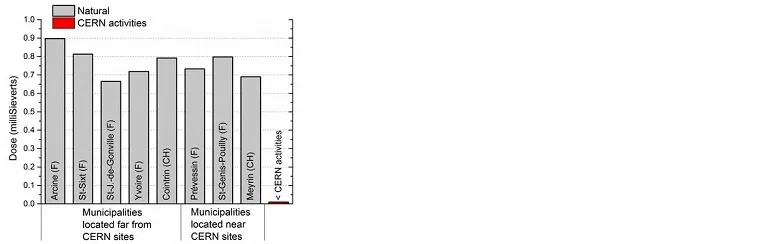
The effective doses to members of the public living closest to CERN and attributed to CERN facilities are so low that they are almost impossible to measure. People living near CERN’s sites receive a maximum annual dose in the range 0.01-0.02 millisieverts, less than 1% of the annual dose received from other sources such as cosmic rays, radon and medical examinations. For example, the average annual dose of radiation in Switzerland is 5.6 milliSieverts (including e.g. contributions from medical activities and plane travels) and in France is 3.7 millisieverts (including e.g. contributions from medical activities and plane travels).
The Swiss Federal Office of Public Health (OFSP) and the French Institute of Radiation protection and Nuclear Safety (IRSN) have both stated that compared to these natural fluctuations, the effect of CERN’s radiation on the public is negligible. This additional dose from CERN is also lower than natural differences between different areas, so that moving between municipalities has a greater effect on annual radiation dose than living near CERN.
Related articles
No posts were found. Try to change the category or the date filters.