CERN launches “Faisceaux d’avenir”, its new public events season 2026/2027
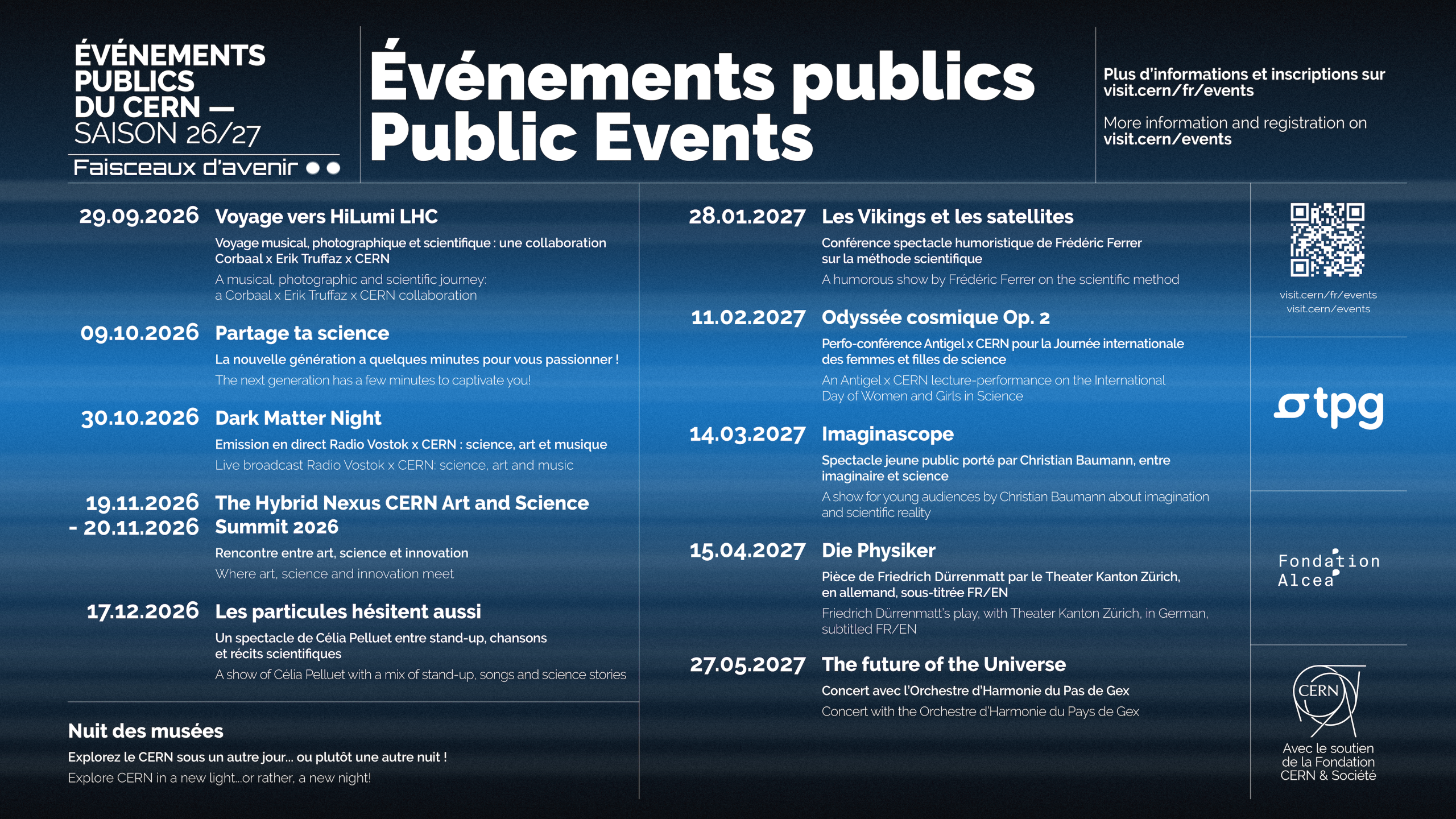
With its new public events season and temporary exhibition, CERN invites audiences to explore science, its future and its place in society.
CERN’s new public events season, Faisceaux d’avenir (Beams of Tomorrow), looks to the future of science and explores its connections with society. Its title draws inspiration from the particle beams circulating in CERN’s accelerators, including the proton beams of the Large Hadron Collider (LHC), which allow scientists to study the fundamental constituents of matter and deepen our understanding of the Universe.
At a time when CERN is preparing for the next phase of the LHC programme, including the High-Luminosity LHC, while also studying possible options for the longer-term future of particle physics, the season provides a space to reflect on questions surrounding the future of science and the generations who will shape it. Through talks, theatre, music, comedy and immersive performances, Faisceaux d’avenir brings together scientists, artists and others to offer audiences different ways of engaging with science through free public events.
In parallel, the temporary exhibition Why? It matters. Matter for Questions will be inaugurated on 7 October and will open to the public on 8 October at the Globe of Science and Innovation. The exhibition will invite visitors to discover the reflections currently taking place at CERN as scientists and stakeholders work to shape the future of particle physics research. It will present an ongoing process, in which scientists, engineers, Member States and international partners are working together to prepare the next decades of research.
The season opens on CERN’s anniversary, 29 September 2026, with Journey towards the High-Luminosity LHC, a journey from CERN’s recent scientific milestones to what lies ahead. Focusing on Long Shutdown 3 and the High-Luminosity LHC, the event will take the form of a conversation illustrated by photographs and videos, accompanied by a science-inspired musical performance by Corbaal x Erik Truffaz.
Throughout the year, audiences will be invited to discover a diverse programme. Dark Matter Night, in collaboration with Radio Vostok, will take the form of a live radio broadcast exploring the mystery of dark matter through science and music. Hybrid Nexus, the CERN Art and Science Summit, will showcase the role of art and creativity in inspiring scientific innovation. Building on last year’s collaboration, CERN and the festival Antigel will join forces once again for Odyssée cosmique, Op. 2.
Other highlights include Les particules hésitent aussi, a stand-up show by physicist Célia Pelluet combining science and music; Les Vikings et les satellites, by Frédéric Ferrer, which uses humour and scientific inquiry to explore climate change, from the history of the Vikings in Greenland to scientific observations of its ice sheet.
The season also gives a dedicated place to younger generations. Partage ta science gives local secondary school students an opportunity to present their research projects to the public, while Imaginascope, by Christian Baumann and Malik Kaufmann, combines improvisation, storytelling and science to encourage curiosity and engagement with scientific ideas among younger audiences and families. The programme will also feature a guest performance of Friedrich Dürrenmatt’s celebrated play Die Physiker (The Physicists), a work centred on questions of science and responsibility, presented in German by Theater Kanton Zürich, with French and English subtitles.
Towards the end of the season, The Future of the Universe will bring together music and science in a concert featuring the Orchestre d’Harmonie du Pays de Gex and drawing on scientific perspectives on the origin and possible future of the cosmos.
Further information about the full Faisceaux d’avenir programme and registration details are available at visit.cern/events.